Swiss Startup Gravis Robotics Raises $200 Million To Turn Excavators Into Autonomous Robots
Gravis Robotics Raises $200 Million from SoftBank in 2026
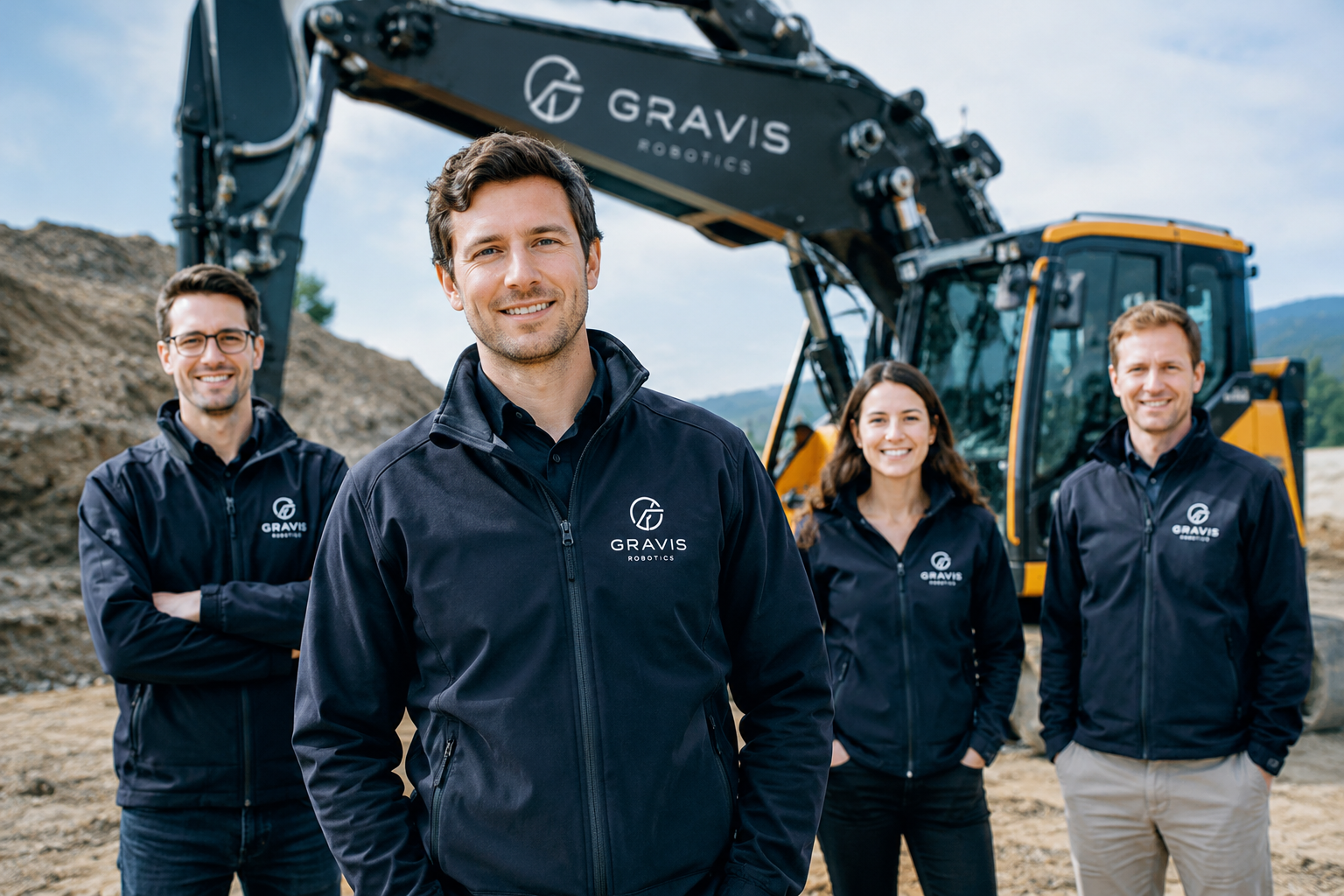
What if a construction excavator could understand the ground beneath it, adjust its movements to changing conditions, and perform certain tasks with minimal human intervention?
That is the idea behind Gravis Robotics, a Swiss technology startup developing artificial intelligence systems that turn conventional construction machinery into intelligent, autonomous equipment.
In August 2026, the company attracted international attention after announcing a $200 million Series A investment from SoftBank, the Japanese technology investment group. The funding valued Gravis Robotics at approximately $1 billion, according to reporting by ETH Zurich and other industry publications. The achievement also made it one of Europe's notable emerging robotics companies. Source: ETH Zurich.
Unlike startups that focus on applications, websites, or software used on computer screens, Gravis Robotics is applying AI to the physical world. Its technology is designed to help construction companies automate activities such as digging, levelling, and moving earth.
The company's story illustrates how European research institutions, engineering expertise, and private investment can combine to develop technology for industries that have traditionally been slow to automate.
For entrepreneurs following Europe's startup ecosystem, Gravis Robotics offers an interesting example of how an unconventional idea can address a major industrial challenge.
What Is Gravis Robotics?
Gravis Robotics is a construction technology company founded in 2022 as a spin-off from ETH Zurich, a leading Swiss university known for its engineering and scientific research.
The company develops hardware and software that can be installed on existing excavators and other heavy construction machinery. Rather than requiring contractors to purchase entirely new robotic vehicles, its approach allows compatible machines to be upgraded with sensors, computing equipment, and AI-powered controls.
This is an important distinction.
Construction companies often own expensive fleets of equipment from different manufacturers. Replacing that machinery with specialised autonomous vehicles could require substantial capital investment and operational changes.
Gravis Robotics aims to make automation more accessible by adding intelligence to equipment that contractors already use.
Its system can support different levels of automation. In assisted-operation mode, the technology provides operators with guidance and information about their surroundings. In more autonomous modes, compatible machines can carry out selected tasks with reduced direct human control.
The company's approach has attracted attention because it applies AI to a challenging environment where the ground, materials, weather, and surrounding activity can change continuously.
How Does Its AI-Powered Construction Technology Work?
Traditional construction machinery depends heavily on skilled operators. An experienced excavator operator must judge distances, control the bucket, respond to changing soil conditions, and remain aware of nearby workers and equipment.
Automating these activities is difficult because construction sites are not predictable environments.
A factory robot might perform a repeated movement in a carefully controlled workspace. An excavator, by contrast, must interact with soil that can contain rocks, compacted material, loose earth, and unexpected obstacles.
Gravis Robotics combines sensors, cameras, machine data, and AI-powered control software to help its equipment interpret these conditions.
According to ETH Zurich's explanation of the technology, the system can build a three-dimensional understanding of its surroundings while analysing information about the machine's operation.
This combination helps the system respond to both the environment and the physical forces involved in excavation.
For example, during an earthmoving task, the machine must account for the changing resistance of the soil and the position of its bucket. Information from its sensors and internal systems can help guide movements and support more consistent operation.
The technology is designed to handle real-world variability rather than simply repeating a fixed sequence of movements.
Gravis also offers Gravis Copilot, which supports human operators with features such as machine guidance and hazard awareness.
Importantly, autonomous capabilities do not mean that every construction task can be completed without people. The appropriate level of automation depends on the machine, site conditions, task, and safety requirements.
Why Is This Innovation Important for the Construction Industry?
Construction is essential to economic development, but many activities remain labour-intensive.
Building roads, houses, commercial facilities, energy infrastructure, and transport networks requires large amounts of excavation and material handling. These activities can be difficult to scale when skilled workers are unavailable or projects face productivity challenges.
Gravis Robotics is targeting several problems that affect construction businesses.
1. Improving productivity
Construction companies need to complete projects within realistic budgets and schedules. Delays in excavation and site preparation can affect subsequent stages of a project.
Gravis says its technology can increase job-site productivity by up to 30% in suitable applications compared with peak manual operation. This is a company-reported performance claim, not a guarantee that every site will achieve the same result.
If independently validated across relevant projects, productivity improvements could help contractors complete certain tasks more efficiently.
2. Addressing workforce challenges
Many construction businesses depend on experienced machinery operators. Recruiting, training, and retaining skilled employees can be challenging in some markets.
Automation could help companies use their existing workforce more effectively by reducing repetitive work and allowing trained operators to supervise multiple machines where the technology and safety procedures permit it.
The aim is not necessarily to eliminate the human role. It is to change how people interact with machinery and manage construction activities.
3. Improving site awareness
Construction sites contain workers, vehicles, equipment, and changing physical conditions. Better sensing and machine guidance can support situational awareness.
However, sensors and AI cannot eliminate every hazard. Proper supervision, safety procedures, equipment maintenance, and site management remain essential.
4. Extending the life of existing machinery
One of the most commercially interesting aspects of Gravis Robotics is its retrofit approach.
Companies may be able to introduce selected automation capabilities without replacing their entire equipment fleet. Compatibility, installation costs, training, maintenance, and expected returns will determine whether this approach makes financial sense for an individual contractor.
The $200 Million SoftBank Investment Explained
On 17 August 2026, Gravis Robotics announced a $200 million Series A investment from SoftBank. The company described it as the largest Series A financing in construction robotics history. Source: Gravis Robotics' funding announcement.
The investment followed an earlier funding round of approximately $23 million announced in November 2025.
The new investment is intended to help the company expand its team, scale its technology, and deploy autonomous machinery across more construction sites internationally.
The reported valuation of approximately $1 billion placed Gravis Robotics among the small group of privately held technology companies commonly described as unicorns.
SoftBank's investment is also significant because it reflects interest in what is often called physical AI: artificial intelligence that interacts with and performs actions in the physical world.
AI is frequently associated with chatbots, image generation, and software assistants. Yet many industries need intelligent systems that can operate machines, manipulate materials, and respond to real-world conditions.
Construction is one potential market for these technologies.
The investment does not guarantee commercial success, but it gives Gravis Robotics substantial capital to pursue its expansion plans and develop its technology further.
From University Research to a Commercial Startup
Gravis Robotics' origins demonstrate the commercial potential of university research.
The company emerged from ETH Zurich's robotics research environment, where engineers and researchers had been working on autonomous systems capable of interacting with the physical world.
One notable example of the broader research behind the technology was an autonomous excavator used in a project involving natural stone construction. In 2023, the machine helped construct a dry-stone wall approximately 65 metres long and up to six metres high, according to ETH Zurich.
Such projects help researchers explore challenges that go beyond moving a robot from one location to another. They involve understanding materials, manipulating objects, and responding to changing physical conditions.
Turning research into a viable business, however, requires more than a successful technical demonstration.
Founders must identify paying customers, develop reliable products, provide support, establish commercial partnerships, and demonstrate that their technology works under operational conditions.
Gravis Robotics has pursued this transition by developing equipment that can be integrated with existing machinery and deployed in construction environments.
Its journey illustrates how a research project can evolve into a business by addressing a practical industrial need.
What Will Gravis Robotics Do With the Funding?
The company's funding announcement points towards international expansion and broader deployment of its autonomous construction technology.
Scaling such a business involves several challenges beyond software development.
First, the company must ensure that its systems work reliably across different machines and site conditions. Equipment manufacturers use different designs, controls, and operating characteristics, making compatibility an important technical consideration.
Second, construction businesses need training, technical support, maintenance, and clear safety procedures before adopting new equipment.
Third, the company must demonstrate that the financial benefits justify installation and operating costs.
Gravis Robotics has highlighted its ability to work across multiple machinery brands. If this compatibility continues to develop, it could make the technology relevant to contractors with mixed equipment fleets.
The company has also described plans to expand internationally, building on its existing deployments and industry relationships.
Its long-term opportunity depends on converting investor backing and technical capabilities into repeatable commercial deployments.
What Can European Entrepreneurs Learn From Gravis Robotics?
Gravis Robotics offers several lessons for founders considering their own startup ideas.
1. Look beyond crowded markets
Many entrepreneurs start by creating another productivity app, online store, or general-purpose software platform.
These markets can offer opportunities, but competition is often intense.
Gravis Robotics looked at a less obvious problem: how to make heavy construction equipment more intelligent.
Entrepreneurs can use the same principle by examining industries where inefficient processes, labour shortages, or outdated technology create genuine business problems.
A less fashionable industry may still contain valuable opportunities if customers have urgent needs and are willing to pay for effective solutions.
2. Solve a problem customers already understand
Construction companies already understand the cost of delays, equipment utilisation, and labour constraints.
Gravis Robotics does not need to convince customers that excavation is important. Its challenge is to show that its technology can improve existing operations.
This is a useful lesson for any founder: connect your product to an outcome that customers can measure.
Depending on the industry, that outcome might be lower operating costs, fewer manual tasks, improved reliability, or faster service delivery.
3. Build on existing infrastructure
Replacing an entire construction fleet would be expensive and disruptive.
By focusing on retrofitting compatible machinery, Gravis Robotics offers a potential route to adopting automation without requiring every customer to replace existing equipment.
This principle applies to many industries. Businesses may find opportunities in tools that improve existing systems rather than forcing customers to start again from scratch.
Examples include software that integrates with established accounting platforms, AI assistants that support existing workflows, and monitoring systems that work with equipment already installed.
4. Combine technical expertise with commercial thinking
Advanced technology alone does not guarantee a successful startup.
Founders must understand how customers work, what they can afford, and what evidence they need before adopting a new solution.
Gravis Robotics' university research background provides technical foundations, while its commercial strategy focuses on construction equipment, industrial customers, and practical deployment.
Entrepreneurs should seek a similar balance between technical development and market understanding.
5. Treat funding as a tool, not the final goal
A major investment can help a company hire employees, improve its product, and enter new markets.
However, fundraising is not the same as building a profitable business.
After receiving investment, founders still need to manage costs, deliver reliable products, retain customers, and establish a sustainable revenue model.
For smaller startups, the relevant lesson is not that every business should pursue a large funding round. It is that capital should support a clear strategy and measurable progress.
Challenges That Could Shape the Company's Future
Despite the investment, Gravis Robotics faces challenges common to emerging robotics businesses.
Construction sites are unpredictable, and autonomous equipment must operate safely around people, vehicles, underground utilities, and changing terrain.
Hardware integration can also be more complex than deploying software alone. Systems must work with different machines, withstand demanding conditions, and receive appropriate maintenance.
Customers will need convincing evidence that automation delivers sufficient value after installation, training, and operating costs are considered.
Competition is another factor. Other companies are also developing autonomous construction equipment and industrial robotics solutions.
Finally, commercial expansion requires strong partnerships and support networks. Contractors may hesitate to adopt new technology if repairs, spare parts, or technical assistance are difficult to obtain.
The $200 million investment provides resources to address some of these challenges, but long-term success will depend on execution, customer adoption, and demonstrated performance.
Conclusion
Gravis Robotics is an example of European entrepreneurship combining university research, artificial intelligence, and industrial engineering to address a practical problem.
Its $200 million Series A investment from SoftBank in August 2026 brought international attention to its mission of making construction machinery more autonomous.
Rather than creating an entirely new fleet of specialised vehicles, the Swiss startup is developing technology that can upgrade compatible excavators and other heavy equipment. Its approach could help construction companies explore automation while making use of existing machinery.
The company's future will depend on how effectively it scales its technology, demonstrates reliable performance, and delivers measurable value to customers.
For entrepreneurs, the most important lesson is that innovation does not always mean inventing something completely new. Sometimes it means taking an existing machine, process, or industry and finding a better way to make it work.
Gravis Robotics shows how a specific industrial problem can become the foundation of an ambitious technology business. Its journey is worth following as Europe continues to develop startups at the intersection of AI, robotics, and real-world infrastructure.