
Quantum Computing: How Europe Is Preparing For The Next Wave Of Business Innovation
Quantum Computing in Europe: Business Innovation and Startups
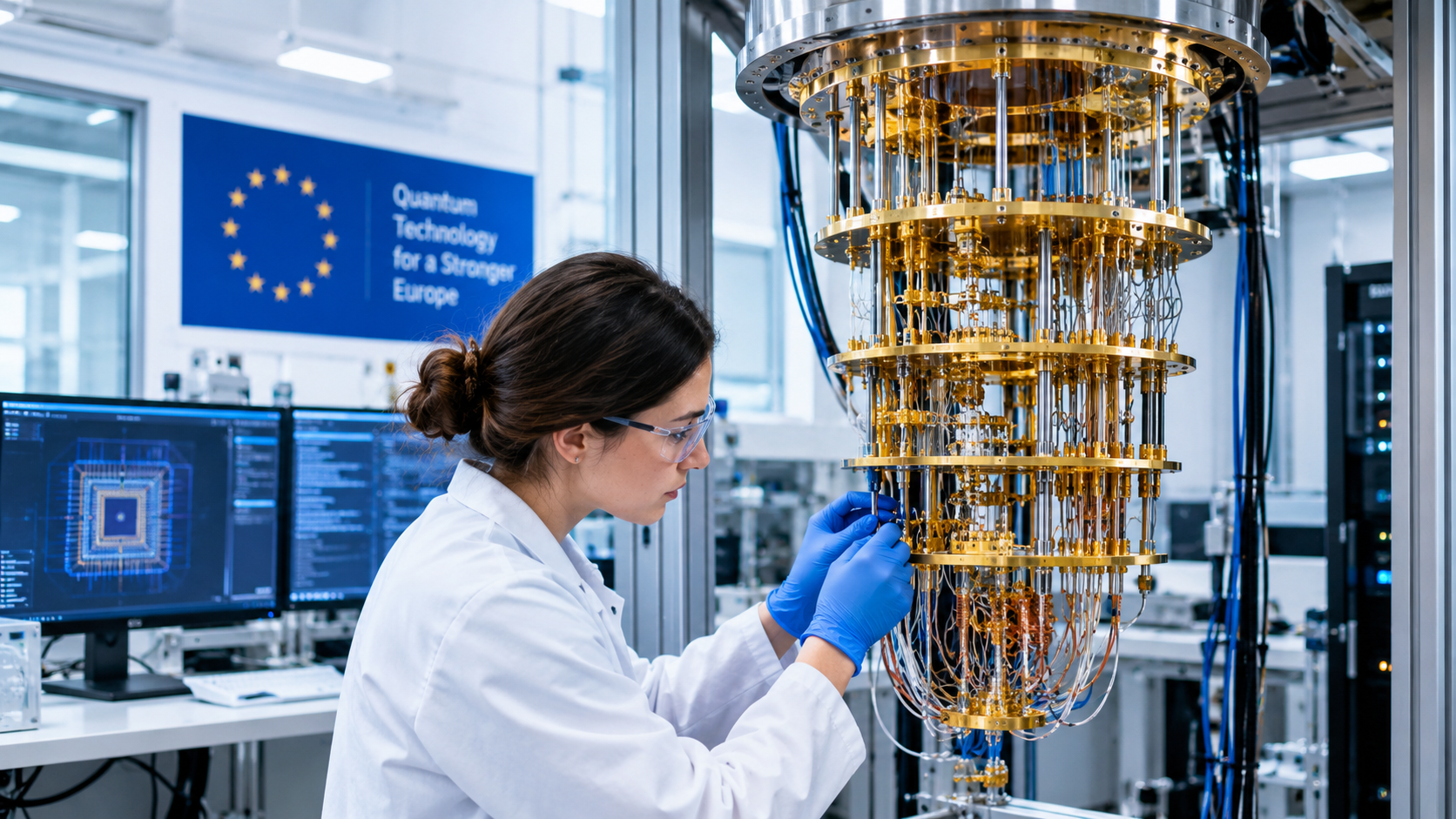
Technology has repeatedly changed the way businesses operate. The internet transformed communication and commerce, cloud computing made advanced infrastructure accessible to smaller companies, and artificial intelligence introduced new ways to analyse information and automate tasks. Now, another technology is attracting the attention of researchers, investors and business leaders: quantum computing.
Although quantum computing remains an emerging field, it has the potential to address certain complex problems that are difficult for conventional computers to solve efficiently. From discovering new materials to exploring complex chemical reactions, the technology could eventually open opportunities across several industries.
Europe is an important participant in this development. Its research institutions, technology companies, universities and public funding programmes are contributing to the development of quantum hardware, software and supporting infrastructure.
For entrepreneurs, the opportunity is not simply about building a quantum computer. It also includes developing software, creating specialist tools, supporting research organisations and helping existing businesses prepare for a technology that could change selected parts of their operations.
Understanding where quantum computing stands today can help European business owners identify realistic opportunities without getting distracted by exaggerated promises.
1. What Is Quantum Computing?
Traditional computers process information using bits, which represent either zero or one. Quantum computers use quantum bits, commonly called qubits, which operate according to the principles of quantum mechanics.
Two important concepts are superposition and entanglement. Superposition allows a qubit to be described through a combination of possible states, while entanglement creates relationships between quantum systems that cannot be explained by treating them as independent systems.
Quantum algorithms use these properties to approach certain computational problems differently from conventional algorithms.
However, quantum computers are not simply faster versions of ordinary computers. They are specialised systems that may offer advantages for particular classes of problems. Most everyday business tasks, including word processing, website hosting and standard database operations, will continue to be handled effectively by conventional computing infrastructure.
Today's quantum systems also face considerable technical challenges. Qubits can be highly sensitive to environmental interference, calculations can be affected by errors, and maintaining reliable quantum hardware is difficult.
Consequently, businesses should view quantum computing as a developing technology rather than a universal replacement for existing computers.
2. Why Is Europe Investing in Quantum Technology?
Europe has a strong foundation in scientific research, engineering, mathematics and advanced manufacturing. These capabilities make quantum technology a natural area of interest for European governments, universities and businesses.
The European Union has supported quantum research through initiatives including the Quantum Flagship, a long-term research and innovation programme launched in 2018. Its wider quantum activities cover areas such as computing, communication, sensing and simulation.
European countries also have their own research programmes, specialist laboratories and technology ecosystems. Collaboration between academic researchers, public institutions and private companies helps move discoveries from laboratories towards practical applications.
There are several reasons why this matters for Europe's economy.
First, quantum technologies could support scientific and industrial research. Second, developing domestic expertise could reduce dependence on technologies controlled by a limited number of international suppliers. Third, specialist companies could create export opportunities in hardware, software, components and technical services.
For entrepreneurs, public research activity can create a market for complementary services. Startups may be able to build tools around existing quantum platforms rather than financing the development of expensive hardware themselves.
This distinction is important because quantum innovation includes a much broader ecosystem than the companies manufacturing quantum processors.
3. Industries That Could Benefit From Quantum Computing
The commercial value of quantum computing will depend on whether it can solve specific problems more effectively than available alternatives. Several industries are exploring possible applications.
Healthcare and pharmaceutical research
Developing a new medicine can involve examining complicated molecular structures, understanding chemical interactions and testing numerous possible compounds.
Quantum computing may eventually help researchers simulate selected molecular systems more accurately or investigate chemical behaviour that is difficult to model using conventional methods.
For pharmaceutical companies, even a meaningful improvement in a specific stage of research could be valuable. Better simulations might help researchers narrow down candidates for further testing or understand the properties of potential drug molecules.
However, quantum computing has not eliminated the need for laboratory experiments, clinical trials or established scientific validation. Many proposed healthcare applications remain experimental, and conventional high-performance computing continues to play a major role in pharmaceutical research.
Startups interested in this field could explore research software, scientific data management, workflow integration and tools that connect quantum experiments with existing computational systems.
Finance and risk analysis
Financial institutions process enormous amounts of information when assessing risk, managing portfolios and detecting unusual transactions.
Quantum algorithms are being investigated for certain optimisation and mathematical problems relevant to finance. In principle, selected applications might benefit from new approaches to evaluating possible outcomes or searching large solution spaces.
Yet commercial advantages remain problem-dependent. A theoretical speedup does not automatically translate into lower costs or better investment performance.
For startups, a more realistic initial opportunity may be building software that allows financial researchers to test quantum algorithms alongside established classical methods. This would help institutions determine whether a particular quantum approach offers measurable benefits.
Manufacturing and materials science
Manufacturers continually search for materials that are stronger, lighter, cheaper or more environmentally sustainable.
Quantum simulation could eventually help scientists understand the properties of complex materials, chemical compounds and catalysts. This could be relevant to batteries, industrial chemicals, electronics and energy technologies.
Europe's established manufacturing and engineering sectors create potential demand for advances in these areas.
A startup might focus on a specialised problem, such as helping a materials research team organise simulation results or compare different computational methods. Such a business could establish relationships with industrial customers before quantum hardware becomes suitable for larger-scale applications.
Logistics and supply chains
European businesses operate complex supply chains involving warehouses, transport networks, production facilities and changing customer demand.
Optimisation problems arise when companies attempt to schedule deliveries, allocate resources or coordinate manufacturing operations.
Quantum computing is being explored as one possible approach to selected optimisation challenges. However, conventional optimisation software is already powerful, and quantum methods do not consistently outperform classical alternatives.
Entrepreneurs should therefore avoid assuming that every routing or scheduling problem requires quantum technology. The strongest business case will emerge only when a specific application demonstrates a practical advantage over existing solutions.
4. Quantum Computing and the Future of Cybersecurity
Cybersecurity is one of the most important reasons businesses should pay attention to quantum technology.
Large, sufficiently capable fault-tolerant quantum computers could threaten widely used public-key cryptographic systems, including RSA and elliptic-curve cryptography. These systems support activities such as secure communications, digital signatures and authentication.
The machines required to break widely deployed cryptographic systems at scale do not currently exist, but organisations cannot assume that sensitive information will remain safe indefinitely.
Attackers may collect encrypted information today in the hope of decrypting it in the future. This is often described as a “harvest now, decrypt later” risk.
In response, cybersecurity specialists are developing and deploying post-quantum cryptography: cryptographic algorithms designed to resist attacks from both conventional and quantum computers.
For European businesses, preparation can begin before practical cryptographically relevant quantum computers become available.
Organisations can identify where cryptography is used, determine which systems depend on vulnerable algorithms, assess long-term confidentiality requirements and plan for cryptographic upgrades.
This creates a near-term commercial opportunity for cybersecurity startups and technology service providers.
Potential offerings include cryptographic asset discovery, migration planning, implementation support, compliance documentation and testing tools. These services address present-day preparation needs rather than relying on speculative quantum computing capabilities.
Businesses should follow standards and guidance from recognised authorities, including the US National Institute of Standards and Technology and relevant European cybersecurity bodies.
5. Opportunities for European Startups
Starting a company that manufactures a quantum processor requires substantial scientific expertise, specialist facilities and considerable funding. Fortunately, entrepreneurs have other ways to participate in the quantum ecosystem.
Quantum software development
Software is a possible entry point for teams with programming and mathematical expertise.
Developers can investigate quantum programming frameworks, build educational tools, create simulation environments or develop applications that connect quantum processors with existing business systems.
The challenge is differentiation. A useful product should solve a real problem for researchers or businesses instead of simply demonstrating that a quantum circuit can run.
Consulting and technical education
Many organisations are interested in quantum technology but lack the internal knowledge to assess its commercial relevance.
Specialist consultants can help businesses understand the technology, identify suitable research projects, evaluate vendors and distinguish realistic opportunities from marketing claims.
Training programmes for software engineers, cybersecurity teams and technology managers can also create demand.
A consultancy should communicate the limitations of current quantum systems clearly and avoid promising results that have not been demonstrated.
Quantum cybersecurity services
Post-quantum cryptography offers a more immediate business opportunity because organisations can begin preparing their systems now.
Startups could develop tools that inventory cryptographic dependencies, assist with migration projects or help technology teams assess their readiness for updated standards.
This market connects quantum-related preparation with established cybersecurity requirements, making it relevant even to businesses that never intend to use a quantum computer directly.
Research partnerships
European universities and research institutions provide opportunities for collaboration through research projects, technology transfer and specialist programmes.
A startup with a clear technical proposition may be able to collaborate with researchers who possess scientific expertise but need commercial partners to develop practical products.
Before entering a partnership, founders should agree on intellectual property ownership, publication rights, funding responsibilities and how future commercial revenue will be handled.
6. How Entrepreneurs Can Enter the Market Without Massive Investment
Quantum technology can appear inaccessible because advanced hardware is expensive and technically demanding. However, entrepreneurs can explore the field without immediately investing in a laboratory or building physical quantum systems.
Step one: Choose a narrow problem.
Begin with a specific industry and challenge. For example, a cybersecurity startup might focus on helping small and medium-sized businesses identify outdated cryptographic dependencies.
Step two: Learn through existing platforms.
Developers can explore publicly available quantum programming tools, documentation, simulators and educational resources. Some providers offer limited free access to quantum hardware or cloud-based experimentation, although availability and usage limits vary.
Step three: Build a proof of concept.
Create a small demonstration that compares a proposed approach with a conventional method. Measure performance, cost, accuracy and practical usability rather than relying on theoretical advantages alone.
Step four: Talk to potential customers.
Interview researchers, manufacturers, software companies or cybersecurity teams. Ask which problems are expensive, difficult or poorly served by existing tools.
Step five: Find research and funding partners.
Depending on the country and business model, founders may investigate university incubators, research grants, innovation programmes and specialist investors. Eligibility requirements vary, so each programme should be assessed individually.
This approach allows entrepreneurs to validate demand before committing substantial capital.
7. Challenges That Could Slow Commercial Adoption
Despite its potential, quantum computing faces significant barriers.
The first is hardware reliability. Many quantum systems remain vulnerable to noise and errors, limiting the complexity of calculations they can perform reliably.
The second is the shortage of specialist talent. Effective development often requires a combination of quantum physics, mathematics, computer science and domain-specific knowledge.
The third is uncertain commercial value. A problem that looks promising in a research paper may not produce a useful advantage when implementation costs, data preparation and operational requirements are considered.
The fourth is competition. Startups must compete with established technology providers, university spin-offs and well-funded international companies.
Finally, hype can distort customer expectations. Businesses may invest in projects without a clear use case, while customers may become sceptical when ambitious promises fail to deliver results.
Successful entrepreneurs will need technical credibility, a well-defined market and a disciplined approach to experimentation.
8. Preparing for the Quantum Future
Businesses do not need to adopt quantum computing immediately to prepare for its development.
Technology leaders can monitor research progress, assess relevant use cases and establish relationships with universities or specialist vendors. Organisations handling sensitive data should pay particular attention to cryptographic resilience and long-term information security.
Startups can take a similarly practical approach. Rather than attempting to predict exactly when quantum computing will transform an industry, founders can build expertise, identify narrow customer problems and test emerging technologies as they mature.
For European entrepreneurs, the opportunity may ultimately lie in the combination of quantum technology with existing strengths in manufacturing, healthcare, financial services, cybersecurity and scientific research.
The companies most likely to create lasting value will not necessarily be those making the biggest promises. They will be those that understand a customer's problem, demonstrate measurable results and know when quantum computing is genuinely useful.
Conclusion
Quantum computing represents a promising area of scientific and technological development, but its commercial impact will unfold gradually and unevenly across industries.
Europe's research capabilities, innovation programmes and industrial base provide a foundation for developing quantum technologies and the businesses that support them.
For founders, opportunities exist in software, cybersecurity, technical education, consulting and research partnerships. Many of these areas can be explored without manufacturing quantum hardware or raising substantial investment at the outset.
The practical lesson is simple: learn the technology, focus on a real problem and validate the business case. As quantum systems improve, entrepreneurs who have developed relevant expertise and customer relationships may be better positioned to turn scientific progress into meaningful business innovation.